
Reflecting on MS2.1 and 2025
Published:
Contents
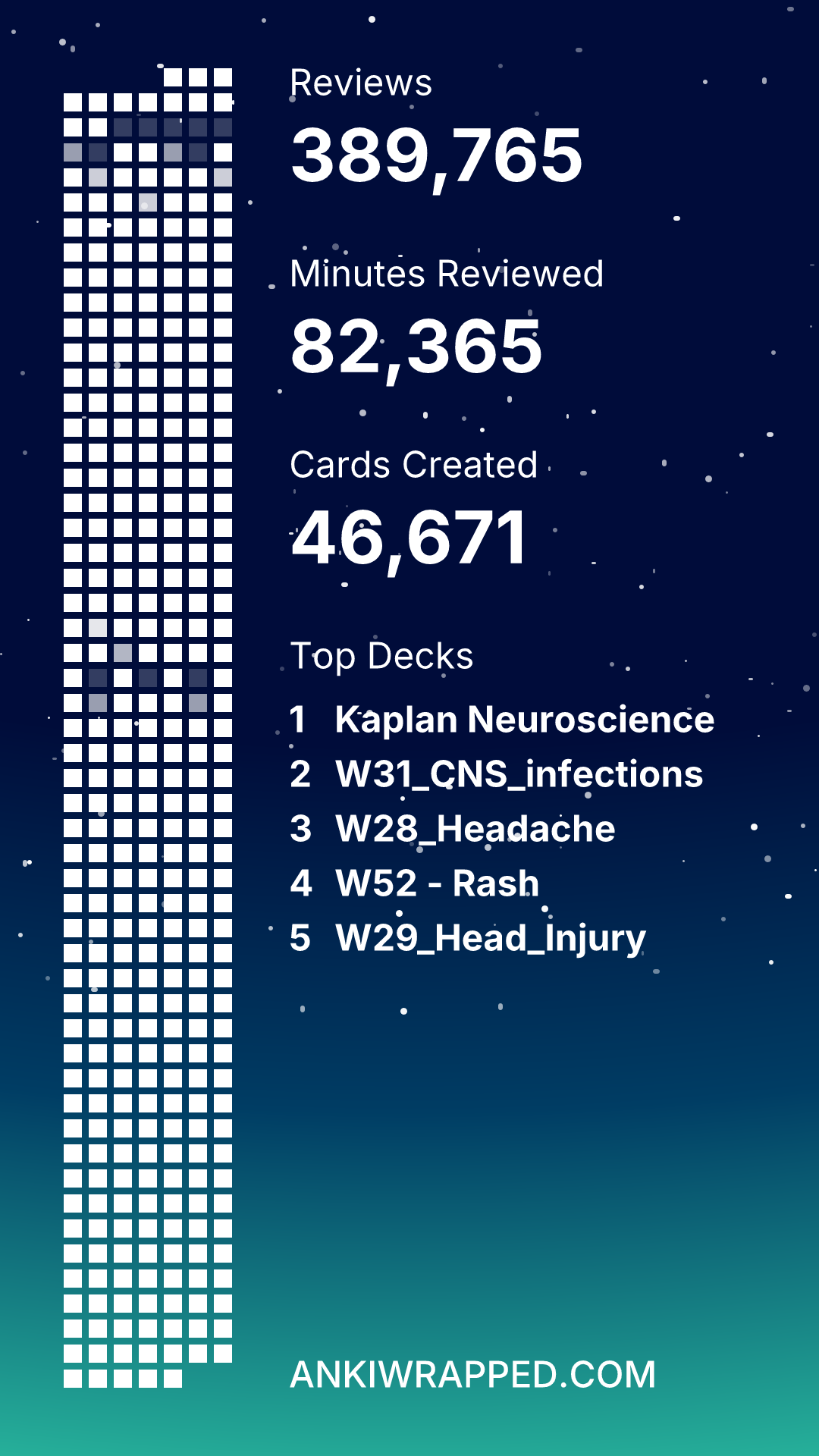
The goal of this post is to reflect on and summarize some of my takeaways about medical school that I’ve learned since my last post eight months ago. But before that, here is a summary of my Anki use in 2025:
2026-01-04-16-40-24
My approach to studying in medical school
Each semester, it seems that I try a radically different approach to studying, so I wanted to briefly comment on the pros and cons of each approach:
MS1 - 1st semester:
I attended most lectures in-person until our first midterm (~1.5 months), after which I watched recorded lectures on my own time, often over the weekend. I relied heavily on pre-made Anki decks from upper-years. However, these were of poor quality, so I chose to spend a significant amount of time rewriting them.
MS1 - 2nd semester:
Initially, I didn’t watch lectures at all, focusing mainly on the recommended readings, e.g. Blumenfeld’s Neuroanatomy by Clinical Cases and Hoffbrand’s Essential Hematology.
Later in the semester, I switched back to watching lectures, but instead of using pre-made Anki cards, I made my own. Doing this for an entire week’s lectures would often take an entire day, sometimes two. However, I felt my cards were well-designed and fit my preferences. See my previous post for more details about the specific changes I felt worked well for me.
Post-MS1 Summer:
I barely kept up with my Anki reviews over the summer, as I was spending most of my time on research, but resumed in June. Initially, I wanted to simply review the cards I had made in MS1, but later decided to tackle the USMLE curriculum via the famous AnKing Step Deck. I followed general advice from others and combined Anki with lectures from Boards & Beyond. Although I hoped to cover several systems over the summer, my primary goal was to keep up with my reviews, which quickly accumulated to 500-1000 or more cards a day.
MS2 - 1st semester:
I tried to continue completing all of my daily Anki reviews as the school year started, and managed to do so for about 6-7 weeks. Unfortunately, I found that there was relatively little overlap between the USMLE curriculum and the material for those weeks (orthopedics). Regrettably, I chose to spend almost an entire week working through pre-made cards for these weeks. I found the difference in the style and quality of these cards jarring, and struggled considerably.
After our midterm, the skipped reviews quickly accumulated, and made keeping up with daily reviews unfeasible. As such, I transitioned to an integrated approach, where I selectively reviewed AnKing cards that overlapped with our material, and supplemented with (rewritten) pre-made cards where necessary. Again, the latter process was time-consuming, but it often helped me cover clinical details that were absent in AnKing/USMLE.
MS2 - Winter:
This was probably the hardest and longest I have ever studied, medical school or otherwise. Unlike the summer, my focus was no longer to clear and keep up with all of my daily Anki reviews (which was clearly unfeasible), but to do a targeted review of specific systems: cardiology → gastroenterology → microbiology → obstetrics/gynecology. Although this approach led to a more manageable number of daily Anki reviews, I was still unable to keep up due to the sheer number of new/forgotten cards I was introducing, as well as their relative difficulty — OB/GYN especially..
In addition to USMLE-related material, I also began reviewing anatomy and radiology because these were consistently my weaker subjects throughout medical school. Currently, I have only done some cursory review, supplemented with videos from Acland’s Atlas, but my goal is to review all topics before beginning clerkship.
Resources I found helpful
Besides USMLE-related materials like the AnKing deck, B&B, and Sketchy, I also enjoyed supplementing some of my learning with the resources below:
- Life in the Fast Lane: a comprehensive site for learning ECGs. I made my own Anki cards from their introductory pages, e.g. on T waves.
- Harvard Wave Maven: a large library of ECGs to practice with, categorized by diagnosis, difficulty, etc. I am currently working through a related Anki deck that was shared on Reddit.
- The Only EKG Deck You’ll Ever Need: another ECG deck that I found on Reddit, based on the book with a nearly identical name. I found this to be very helpful in understanding basic ECG patterns, although it was a bit overkill for our curriculum.
- Basic Radiology Deck: another Reddit deck. I haven’t figured out what the source material was, but it seems to be a mixture of an e-book and Radiology Assistant. Compared to an earlier radiology deck I previously kept (Ranki), I find this deck to be much more manageable and beginner-friendly.
- Kush GSSE Anatomy Deck: a deck designed for the Australian GSSE, which I understand to be a post-medical school exam for those hoping to enter surgical specialties. In any case, it is based on Last’s Anatomy, and thus represents a far more concise (and hopefully, practical) review of gross anatomy compared to a previous deck I attempted learning with (Radiopaedia deck). My progress in this deck has been slow because, while mostly well-written, the cards are not exactly beginner-friendly. As mentioned above, I have been supplementing my anatomy review with videos from Acland’s Atlas, but I have also found it incredibly helpful to have Netter’s open while reviewing cards from this deck.
Comments on Anki
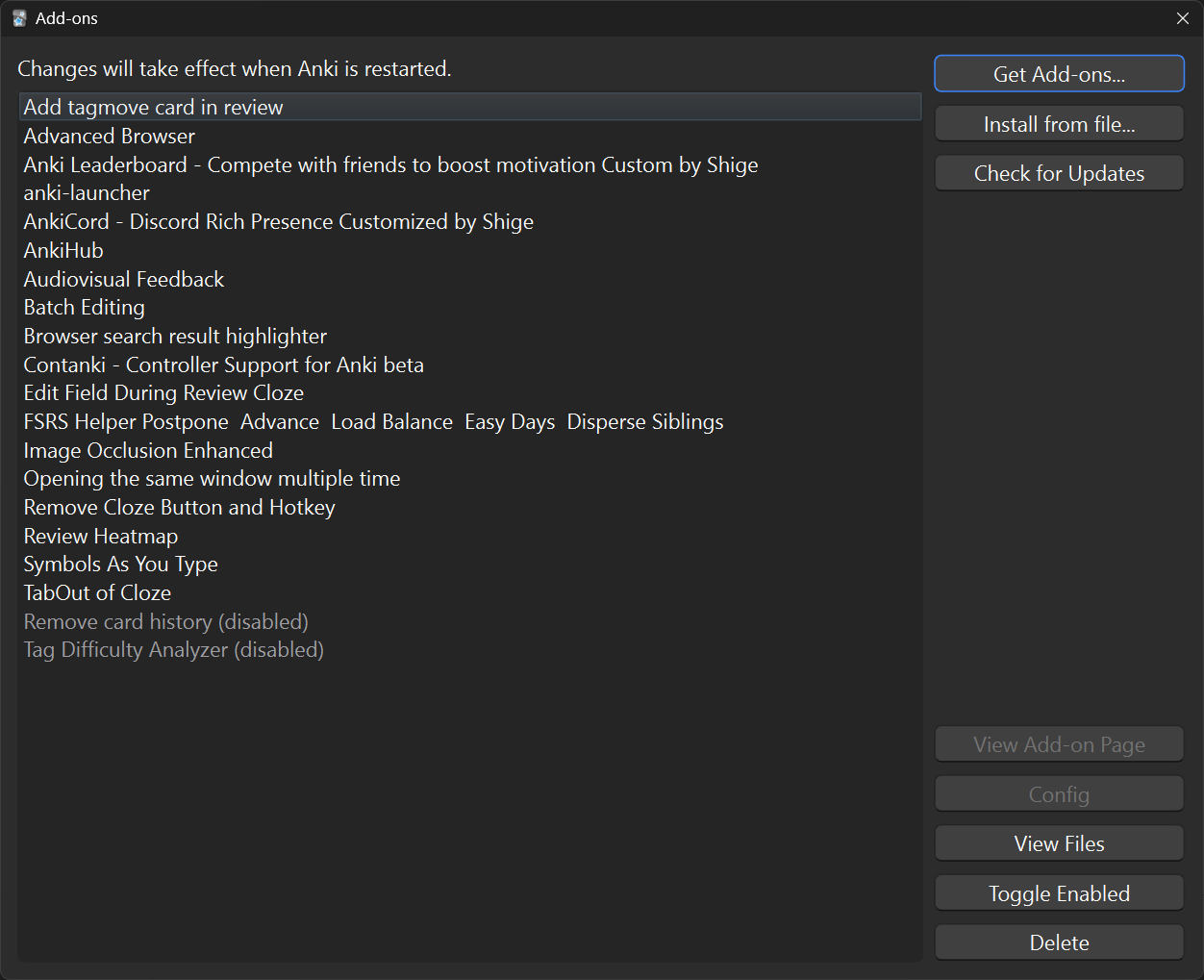
As with my previous post, I wanted to share an update on my Anki workflow, so here are the add-ons I have currently:
2026-01-04-16-45-17
There haven’t been many major changes, besides the addition of FSRS Helper and AnkiCord.
More importantly, I have recently come to prefer the Ascending Retrievability order for reviews over Descending Retrievability. Some advantages of this are:
- If I cannot complete all reviews in a day, I am at least guaranteed to see the cards I struggle most with.
- I am able to work through the most difficult cards in a fresher state of mind; conversely, seeing more familiar cards at the end of a review session almost feels like a reward.
Summary and Resolutions
I want to begin this section by summarizing what I think worked well for me:
- Integrating 3rd-party resources with our own curriculum: although imperfect and perhaps a waste of time, I find combining multiple resources (mainly, AnKing/USMLE) has helped me achieve a stronger and broader understanding of topics in our curriculum.
- Discipiline: the vast breadth of topics in medicine is overwhelming, and the only logical solution I have come across is maintaining consistency with my studying and Anki reviews.
Looking forward to the rest of 2026, here are some goals I think should be achievable:
- Dedicate more time to research, anatomy, and radiology, e.g. 3h/week on research, 1 system every 1-3 weeks for anatomy/radiology (the large spread accounts for how difficult the GSSE deck is for me).
- Integrate more practice problems into my study routine, instead of solely relying on Anki. I began doing this last semester with nephrology and dermatology, which I found helpful to consolidate concepts.
- Regularly working through/memorizing schemas from the Calgary Black Book, e.g. 1 chapter/week.
And that’s it. Looking forward to the rest of MS2!